ACE COMBAT 8 Best Planes: What to Fly First (2026 Update)
Which aircraft to fly first in ACE COMBAT 8 after launch: the opening hangar — F/A-18C, F/A-18E, F-2A, F-14D — matched to mission benchmarks.
FAQ
What is the best first aircraft in ACE COMBAT 8?
Which aircraft do the wingmen fly by default?
When should I switch away from my first aircraft?
Does the pre-order F-14A differ from the F-14D?
What is the best plane in ACE COMBAT 8 after launch?
The confirmed opening hangar
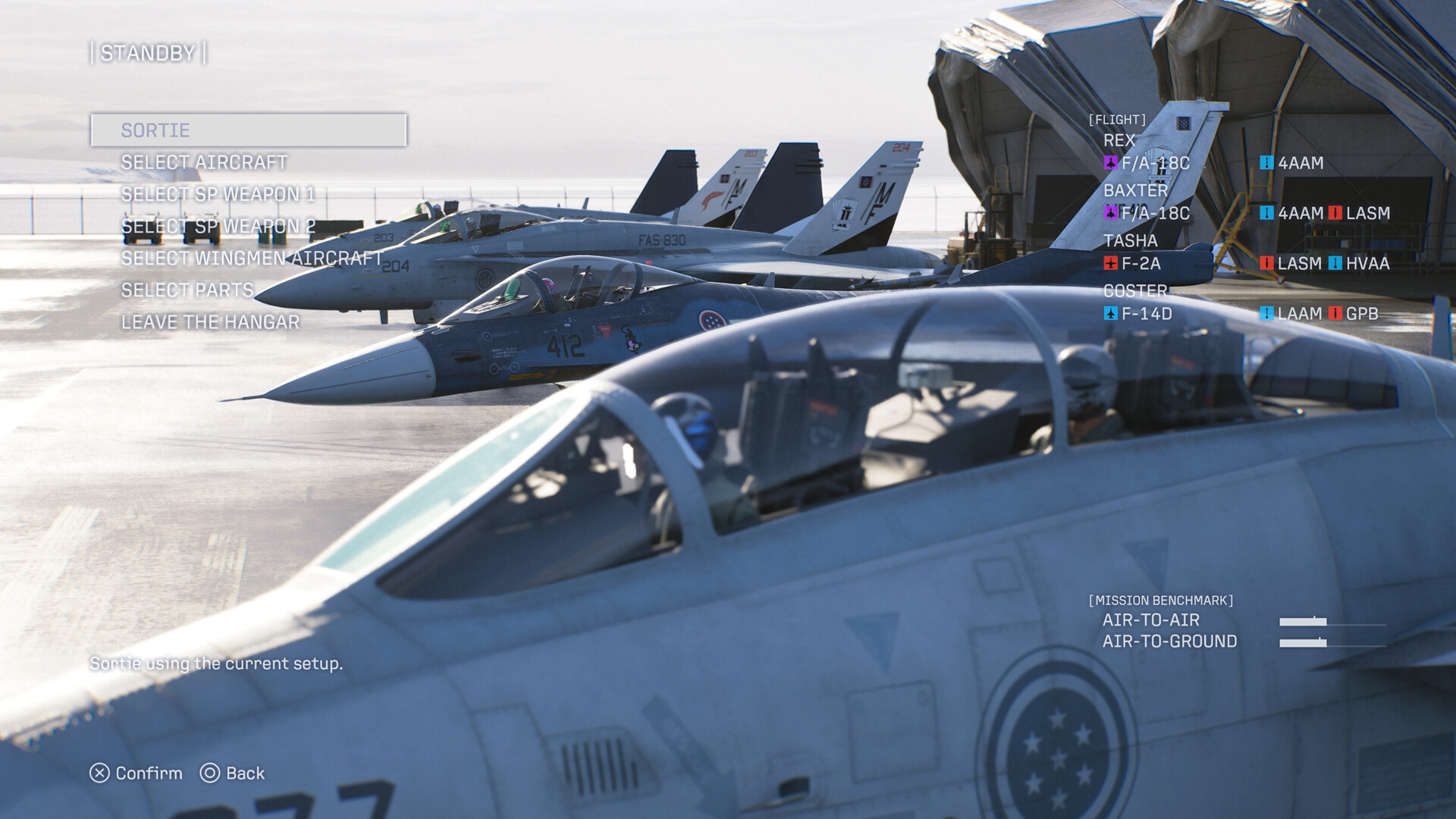
Launch rosters grow fast in this series, but official screenshots already frame your first sorties: the flight defaults to Hornets. The F/A-18C leads, a second Hornet sits on the wing, TASHA’s F-2A and COSTER’s F-14D complete the four-plane group. That default composition is a quiet tutorial in itself — one balanced leader, one nimble multirole, one heavy interceptor.
F/A-18C: the default and why it works
The F/A-18C is the aircraft the game puts you in, and the benchmarks justify it. Multirole airframes exist precisely for rosters that mix drone intercepts with ground strikes, and the opening campaign — defensive fighting against Sotoa’s invasion — is exactly that mix. In screenshots the F/A-18C carries a 4AAM multi-lock missile, the most score-efficient tool against drone groups (see the score and ranking guide).
Fly the Hornet until you notice which half of the benchmark you keep failing. That is the signal for your second aircraft.
F/A-18E: the same idea, more of it
The hangar screenshots show the F/A-18E parked alongside the C-model — the bigger, newer Super Hornet. Its precise handling differences are not published, but its role in the lineup is clear: it is the multirole branch for pilots who like the Hornet’s balance and want more of it as tougher missions arrive. If the C-model feels comfortable but underpowered mid-campaign, this is the confirmed upgrade path.
F-2A: the nimble all-rounder
TASHA’s F-2A is the interesting one: a smaller, agile airframe carrying LASM and HVAA in the roster screenshots — anti-ship reach plus a high-speed missile on the same plane. That combination is what the two-slot weapon system rewards (the special weapons guide covers both slots). If you find the Hornets sluggish in dogfights but still need ground reach, the F-2A is the confirmed bridge.
F-14D: for when the sky is the mission
The F-14D appears with LAAM and GPB — a long-range air-to-air missile and a precision bomb — which reads as the interceptor profile: engage hostiles far from the target area, then handle a few ground objectives from safety. On benchmark-heavy air-to-air missions, especially against named squadrons like the black interceptors of Lux Lunae (see aces and wingmen), starting on an interceptor frame changes the whole tempo of a mission.
A decision framework, not a tier list
The game is out now, and the post-launch consensus is real: the best planes guide collects it — the F-22A Raptor for air superiority, the F-35C Lightning II as the all-rounder. Those sit deep in the Aircraft Tree, though, and MRP is scarce in the opening act. Until those unlocks are affordable, use this four-question check before every sortie:
- What does the benchmark rate higher — air-to-air or air-to-ground?
- What is the main target type? Drone swarms want multi-lock missiles; vessels want anti-ship weapons; hardened structures want penetrators.
- What are your wingmen carrying? The parts and loadouts guide shows how to spread coverage across the flight instead of duplicating it.
- Which half of your last mission felt bad? Switch toward the airframe class that fixes that half.
From starter hangar to Aircraft Tree
The starting four are only the first page of a 34-aircraft roster. Once MRP starts flowing from mission scores, the Aircraft Tree unlocks new airframes — with parts bought from the same tree, so every purchase competes with your equipment (the parts and loadouts guide covers the slot system). The full airframe-by-airframe breakdown lives in the aircraft list, and the pre-order F-14A plus the Deluxe Edition’s Morgan — usable online from day one through the Premium Ace Pass Plus voucher — round out the early hangar. The campaign’s own airbase, the carrier FCU Endurance, is where you will meet all of them — the campaign overview sets that stage.
Related Articles
aircraft
ACE COMBAT 8 Best Planes: The Post-Launch Aircraft Guide
The best aircraft in ACE COMBAT 8: the F-22A for air superiority, the F-35C as the all-rounder, fictional endgame crafts and Aircraft Tree unlock order.
guides
ACE COMBAT 8 Controls: Standard vs Expert, PC Keys and Flight Sticks
Every ACE COMBAT 8 control scheme explained: Standard vs Expert flight models, the two-trigger speed action, PC keyboard keys, HOTAS support and the VR situation.
aircraft
ACE COMBAT 8 Aircraft List: All 34 Planes, Classes and Unlocks
The ACE COMBAT 8 aircraft list after launch: 34 planes in four roles, Aircraft Tree unlocks, MRP costs, DLC additions and the hostile types.
Was this helpful?
Thanks for the feedback!