ACE COMBAT 8 Aces and Wingmen: Lux Lunae, Joker Flight Tactics
Ace combat in ACE COMBAT 8: the no-weak-point damage model, the Lux Lunae 55th Unit, wingman Disperse and Attack orders and keeping your flight alive.
FAQ
Who are the ace enemies in ACE COMBAT 8?
How does the new damage model change ace fights?
Can I command my wingmen in ACE COMBAT 8?
Do wingmen choices matter to the story?
Ace fights without weak points
The single biggest tactical change in ACE COMBAT 8 is structural: enemies no longer have specific weak points. Previous entries taught you to strip an ace’s special panels, or to line up the one exposed intake on a superweapon. Here, damage lands from any angle, and destruction cascades — a killed aircraft can damage its neighbors as it falls.
Two consequences follow for every duel:
- Positioning beats hunting. With no weak-point lottery, sustained firing solutions are the whole game: stay in front of an ace, deny their angles, and the damage accumulates.
- Density is danger and opportunity. Aces who fly close to their escorts risk chain damage when kills land — yours or theirs. Engaging a formation head-on invites cascade kills; engaging from the edge keeps you out of falling debris.
The confirmed large targets behave the same way: the giant airborne vessel exposes destructible SUB PROPELLER sub-targets worth +200 each, rewarding sustained passes across its length rather than a single magic spot (the score and ranking guide lists the confirmed values).
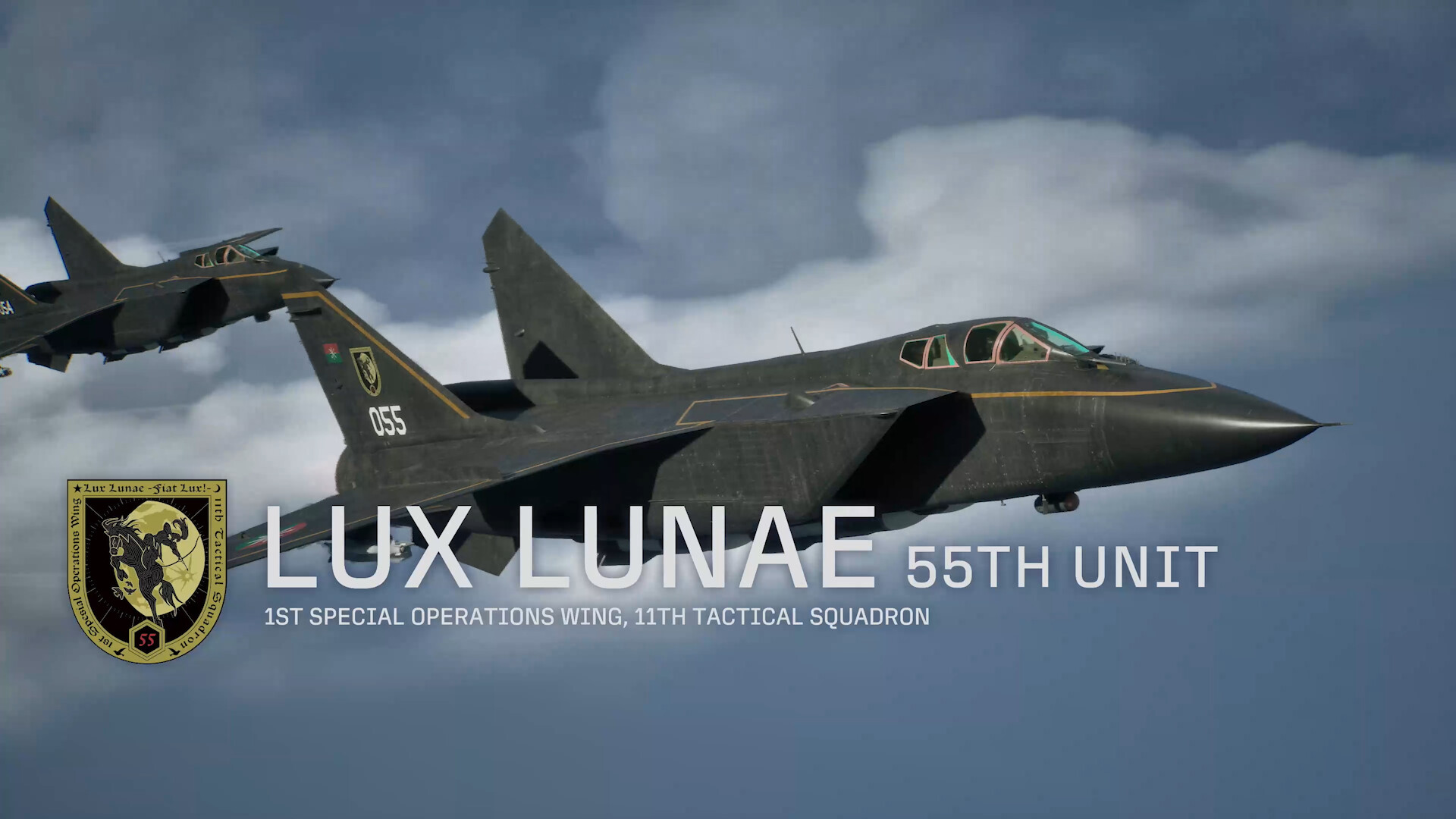
The confirmed aces: Lux Lunae, 55th Unit
The war’s named opposition arrives with a formal introduction card: LUX LUNAE — 55TH UNIT, 1st Special Operations Wing, 11th Tactical Squadron, motto “Lux Lunae - Fiat Lux!”. Their black-and-gold interceptors fly in pair formation against heavy overcast — the classic ace-squadron silhouette, and the unit most likely to define the campaign’s hardest duels.
No individual pilot names within the unit are published yet, and this page keeps it that way until confirmation. What the card itself confirms: Sotoa’s war effort fields organized special-operations aviation, numbered like the ace units of every earlier Strangereal war.
Your flight: three wingmen, three airframes
Your side of the duel is Joker Flight — you (the silent weapon systems officer flying as the inherited Wings of Theve) plus three wingmen whose loadouts you control before every sortie. Confirmed from the sortie roster:
- Tasha Severskaya — F-2A, LASM + HVAA in screenshots. The flight’s agility pick with stand-off reach.
- William “Noise” Coster — F-14D, LAAM + GPB. Long-range intercepts plus precision ground work.
- Ellington “Professor” Baxter (LCDR, FCU Navy) — F/A-18C or F/A-18E, 4AAM + LASM or SOD/QAAM depending on the mission. The flexible second.
The full profiles, and the story weight behind the Rex identity you fly under, are in the story and characters guide.
Orders: Disperse and Attack
Screenshots confirm an in-mission command layer for the flight’s special weapons: an SP WEAPON DISPERSE / ATTACK toggle, and a radio call of “Dispersed Attack” as the flight’s munitions scatter across multiple targets — radar towers and SU-25SM attackers in the same pass over the snow valleys.
Used well, orders are the difference between clearing a multi-target group and cherry-picking it:
- Disperse when targets outnumber your missiles: four aircraft splitting multi-lock and precision weapons across a spread of targets outscores any solo pass.
- Attack when one target must die now — an ace on a wingman’s tail, or a sub-target window on the airborne vessel.
Because wingmen fly what you assign them (the parts and loadouts guide covers the roster screen), a flight armed with complementary special weapons makes Disperse dramatically more effective: a 4AAM salvo, an LASM and a GPB landing in the same second is a spread no single aircraft can replicate.
Keeping the flight alive
The series tradition this entry continues: your decisions influence whether the people beside you survive the war, even though the plot’s destination is fixed. Concretely, three habits carry weight:
- Kill what shoots at your flight. Hostile drones and attackers confirmed so far (MQ-19 at +100, SU-25SM at +340) are exactly the types that pressure wingmen — and they pay score.
- Order Disperse before the sky fills. The command exists to prevent the moment six bandits converge on one wingman.
- Watch the DMG readout. Screenshots show a damage percentage on the HUD; a wingman at high damage loses the fight they are in, wherever it is.
Ace units test all three habits at once. When Lux Lunae’s interceptors meet Joker Flight over Usea, the pilot who manages the flight — not just their own aircraft — wins the exchange. The campaign overview sets the war around those meetings, and the beginner guide gets new pilots to that level fast.
Related Articles
aircraft
ACE COMBAT 8 Aircraft List: Every Confirmed Plane at Launch
Every aircraft confirmed for ACE COMBAT 8 at launch: 30+ airframes in four classes, from the F/A-18C and F-14D to the pre-order F-14A and the Morgan.
campaign
ACE COMBAT 8 Campaign Overview: The 2029 Sotoa-Usea War
The setting of ACE COMBAT 8: the 2029 Sotoa-Usea War in Strangereal, Tonitrus Spears, Joker Flight and the carrier FCU Endurance, minus the spoilers.
aircraft
Best Starting Aircraft in ACE COMBAT 8: What to Fly First
Which aircraft to fly first in ACE COMBAT 8: the confirmed opening hangar — F/A-18C, F/A-18E, F-2A, F-14D — matched to mission benchmarks.
Was this helpful?
Thanks for the feedback!